-01.svg)

.avif)

It's tempting to imagine a parallel universe where the GT1 stuck around, a permanent fixture under the direction of the GT department, where Le Mans Hypercar fantasies come with cup holders and a stereo. RML Group has cottoned onto this idea. The Wellingborough-based firm hasn't just pondered the question – they've built a 907bhp, carbon-bodied Einstein-Rosen bridge.
The pedigree doesn’t get much better. Founded in 1984, RML has scored multiple British and World Touring Car Championship titles, and two LMP2 class wins at the 24 Hours of Le Mans. In recent years, they’ve expanded their engineering division and assisted OEMs with special projects such as the Nio EP9 electric hypercar, and the Nissan ZEOD RC – the first car to complete a lap at Le Mans on electric power alone.

In 2017 they road-legalised an Aston Martin Vulcan, followed by the Short Wheel Base in 2022 – a Ferrari 550 Maranello-based interpretation of the 250 SWB. RML clearly could have road legalised a 935 or a GT2 RS clubsport for what’s internally known as Project 39, but instead came up with the car I'm here to drive, externally known as the GT Hypercar.
The starting point for every build is a 992.1 Turbo S sourced from the customer’s domestic market. Typical of a successful racing outfit, RML creatively interprets the rules to its advantage, with the donor cars going through an “extensive service” to become a GT Hypercar. This approach ensures homologation for use on its owners’ favourite roads and tracks are unchanged, and all local taxes are already paid. Not only is it an ingenious move for circumventing bureaucracy, it also ensures the car stays on brief, creating a fitting parallel to the original GT1.
Technicians remove the engine and peel away the 911’s outer husk, leaving just the core structure to which a new carbon fibre skin is fitted. The most impressive component is the GT1-aping clamshell that stretches from the A-pillar to the rear deck: it makes up 50 per cent of the GT Hypercar’s bodywork yet weighs just 19kg.


With all new panels bonded and fixed into place, the extreme silhouette is complete. The fit and finish is exquisite; it may look like a 90s racer, but the shut lines and panel gaps are up there with the best boutique supercar makers. With the body complete the car then moves through paint and into the assembly room where its new interior is installed.
The engine returns to its mounts following a trip to renowned tuners Litchfield, the 3.7-litre twin-turbocharged flat-six gains new software and makes the most of its straight air intakes, liberating an additional 266bhp and 147lb-ft (200Nm). Despite the hypercar-baiting outputs of 907bhp and 737lb-ft (1,000Nm) of torque, the carbon brakes and PDK gearbox remain unchanged. The suspension is brand new though, with active hydraulic dampers from R53 – the same company which supplies dampers for the GMA T.50. Revised links and top mounts are also fitted to each corner.
I get to see 3 cars in various states of build, each with a unique specification based on its owner’s desires. It surely can’t be long before one emerges with a race-inspired livery. They’re all stunning in their own right, but the one that gets my attention is Car 0.

The validation prototype resembles a 911 GT1 Straßenversion with its silver bodywork, and looks like what would’ve emerged from Weissach if the GT1 became a permanent fixture in the model range. Having gained 90mm in width, 130mm in length, and a gigantic aero package to make a Pikes Peak racer green with envy, it’s all business.
The rear deck and quarter panel blend together extruding the rear of the car, striking a resemblance to the 2019 935, both of which have the look of a 911 wearing an exoskeleton. The active rear wing sits above a gargantuan diffuser housing the cannon-like twin exhaust pipes.
At the front, its doors fade into the arches leaving most of the tyre on show, with the protruding front splitter and air channels telling me how it wants to bend physics to stick to the road. The GT Hypercar sits mean on its forged wheels, looking like a skunkworks project that came from a highly classified military program. If RML told me it was made of weapons-grade materials and fuelled by kryptonite I’d believe them.


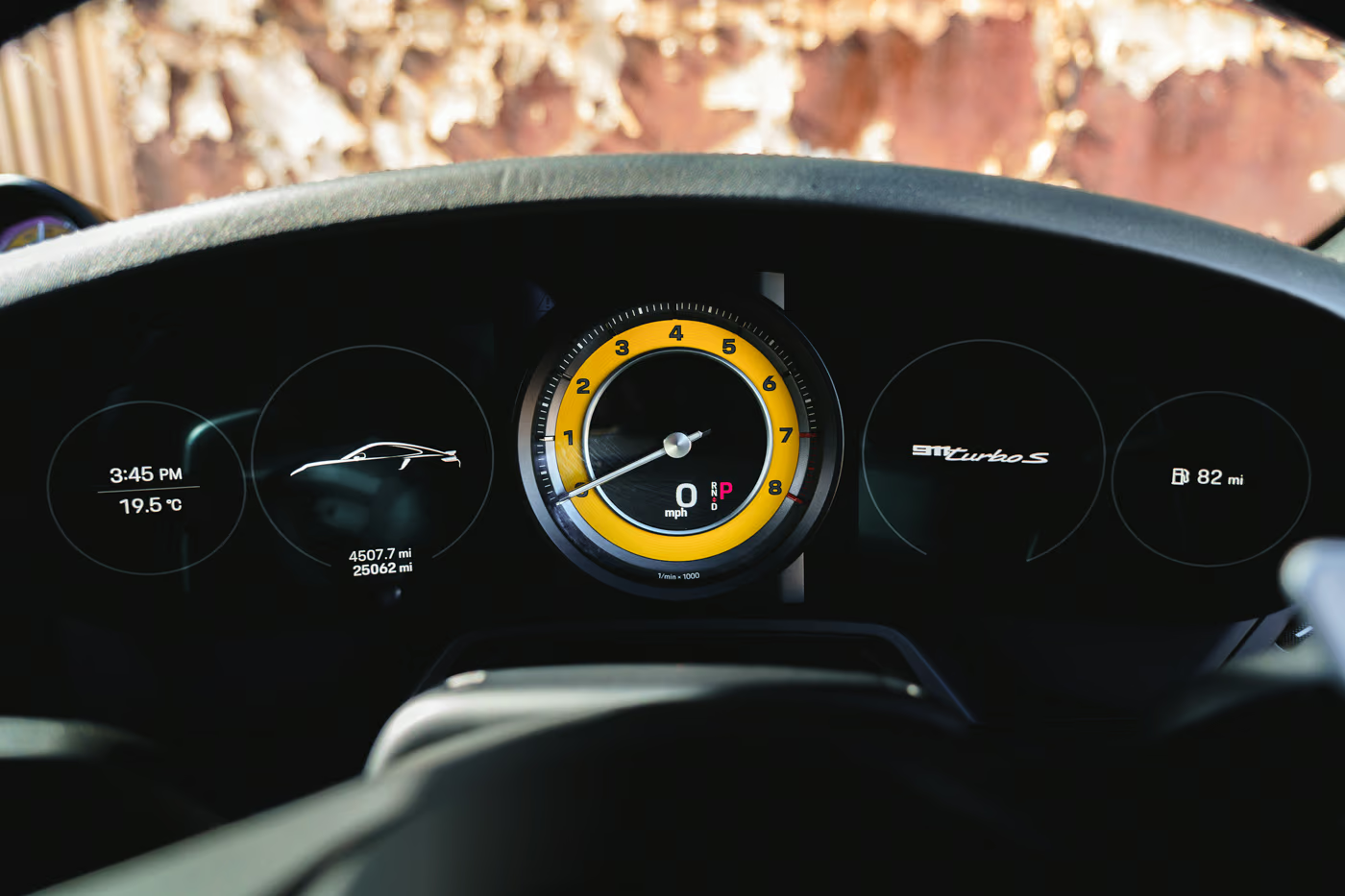
Directed into the fixed-back carbon bucket seats and choosing the regular three-point seatbelt over the multi-point harness, I’m given a rundown by Head of Operations Simon Croft. I haven't had to fold myself through a letterbox-like aperture, nor have I had to don a pair of headphones. It feels rather civilized, essentially a normal 992 user interface aside from the new steering wheel featuring four dials: one for adjusting aerodynamics, ride, damper, and drive mode parameters. For the road it’s recommended to set the powertrain and dampers to their normal settings; there’s no need for the active aero or selectable tarmac-kissing ride height just yet.
A twist of the starter makes the GTH roar into life. The sound from the Inconel exhaust wouldn’t be out of place in an IMSA race pit lane. You know the phrase “speak softly and carry a big stick”? This isn’t that, it’s more shout loudly whilst clutching nuclear launch codes. With my heart rate still elevated from the gruff rumbling post cold-start, it takes a few minutes to acclimatise to its 1990mm width but I soon settle in. It’s surprisingly easy to place on the road and offers great visibility; I almost forget what I’m in command of, but checking the side mirrors offers a glimpse of the enormous rear wing and ludicrously flared arches. I can’t help but giggle at the sight.
I amble through town with ease, only breaking a sweat when navigating the tightest junctions or having to do a three or four-point turn; the GT Hypercar requires a wide radius to double-back on itself. For the most part, the control weights are undemanding, the steering is light, and the twin-clutch automatic gearbox shifts imperceptibly; driving the car in stop/start traffic is effortless. Apart from dodging the occasional gawping onlooker this is easy street. It has to be said that when you’re behind the wheel of something that looks like it’s escaped from Area 51 you get attention. For the shrinking violet, or quiet wall flower of a person I’d recommend you steer clear. It's pure theatre from the outside and everyone wants to be in the front row.
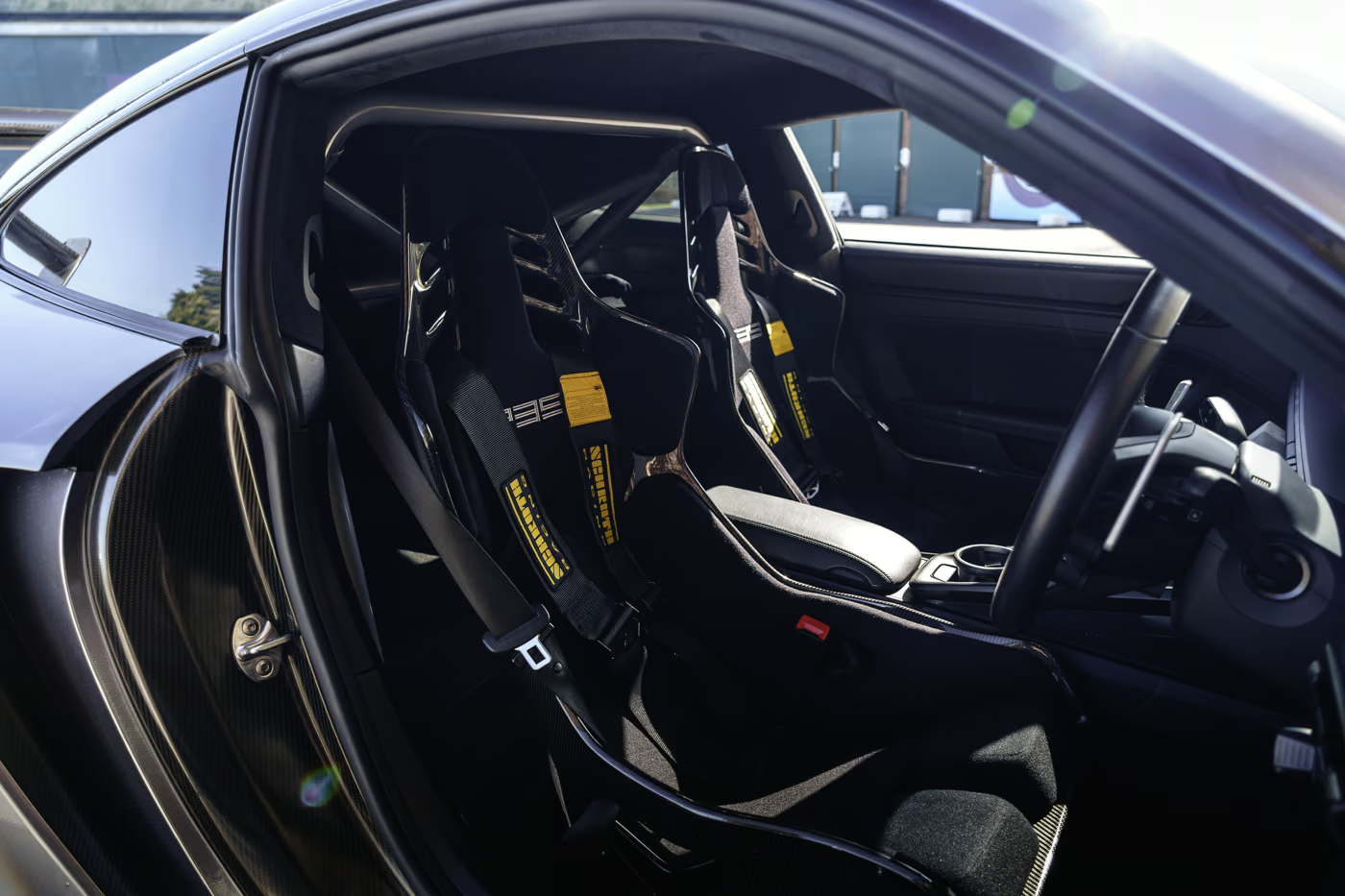

Dawdling around town gives me an opportunity to enjoy the cabin which unlike so many road going racers is a pleasant place to be. There’s a powerful air conditioning system, punchy Burmester surround-sound, and Apple CarPlay that functions perfectly. Even the rear view camera – necessitated by the removal of the rear glass to make way for the roof-mounted air intakes – works well, but having no rear window does take some getting used to.
The car has endured 25,000 hard development miles but there’s not a squeak or rattle to be heard: a testament to RML’s workmanship. While the interior of Car Zero is on the restrained side, there is plenty of scope for a more flamboyant environment to be created as part of the conversion. Given its track-focused nature, it’s no surprise that the rear cabin is dominated by a fixed roll cage, but the space within the frame could easily host a helmet storage solution – something very useful for drivers like myself with a circuit as their destination.
With the traffic clearing and the roads opening up comes my first chance to tickle the throttle. The induction noise of air being mistreated overhead paired with the chuffing and surging of two hungry turbochargers is intoxicating. With the front end rising under power, the steering goes slightly light as the rear hunkers down to deliver an earth-moving shove. I’ve reached 70mph in an instant, and am suddenly aware of the vast amount of performance the GT Hypercar has on tap – and this isn’t all of it. The normal driving mode limits the power to just 740bhp.

At a cruise, the engine is smooth and the turbos are quiet, but there is an unavoidable droning from the exhaust between two and three thousand revs. Above or below this threshold it’s unobtrusive, unless the valves are opened to deliver an LMP-style soundtrack at all engine speeds. One in-gear pull with the exhaust set to loud is an addictive experience; absolute power does indeed corrupt absolutely.
The chassis is stable and doesn’t follow the cambers of the road. It rides Britain’s torturous roads well, eating up fractured surfaces and drain covers with ease. There’s definitely a firmness to the chassis, but compliance comes with it. Not once do I feel a wince or shudder through the active dampers – exactly as I expected from a car built to the GTH’s brief. Approaching a run of curvaceous, flowing tarmac I engage Sport mode to unlock the 907bhp engine map and select manual shifting. Instantly the car feels like it’s working as intended.
I pour into bends with accuracy thanks to the responsive and reassuringly weighted steering, giving me confidence that the GTH can easily handle whatever comes next. There’s a hint of roll but it feels well judged and naturally flows through the scenery; the body is kept in check and works with me in faster bends. Exiting slow corners, the traction is unfathomable as the car never once scrabbles for grip from its Michelin Pilot Sport Cup 2 R tyres. Instead it will slightly squirm on the rear dampers before grabbing the surface and firing me out with relentless pace. It’s sure-footed and approachable, having an intensive ability to shrink country roads and cover them at an unbelievable rate.
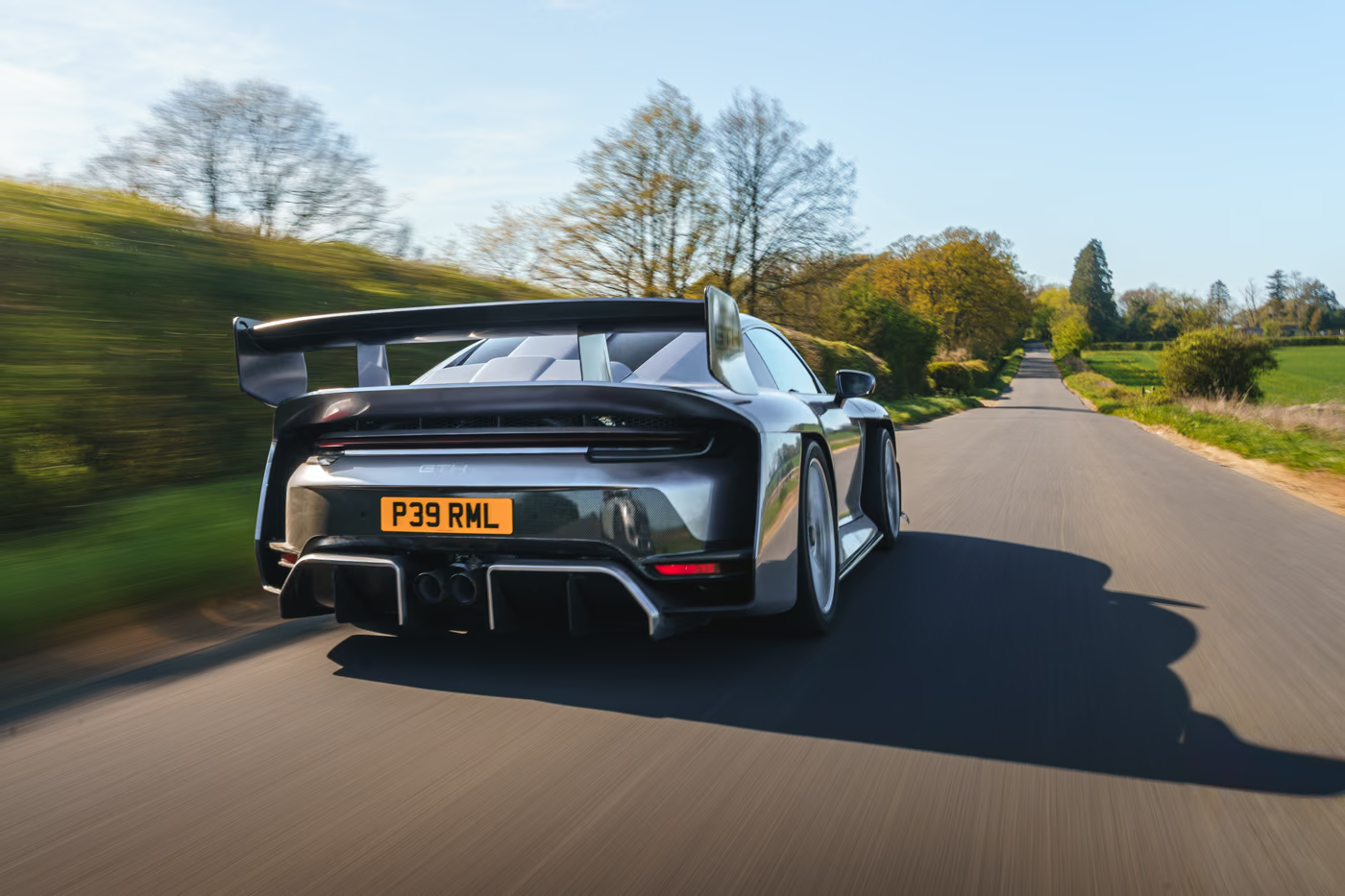
To say overtaking mobile chicanes is easy would be an understatement – I simply can’t imagine a gap too small. Pull out, stab the throttle, and within moments you’ve passed the blockage and are in the next county. Restraint must be exercised however, as 907bhp means big numbers appear in an instant. But when the road is clear and the sight lines check out, I can experience the flat-six’s full might for just a few seconds, being pressed into the seat as the scenery blurs around me. It’s so fast that it could replace Road Runner and become Wile E. Coyote’s new arch nemesis.
With no insatiable cartoons visible in the rear view camera, I prepare to stretch the GTH’s legs properly on track. Laid out on the former taxiways of the ex-RAF base, the clockwise circuit at Bicester Motion features sharp curves connected by fast straights. The racing harness replaces the traditional seatbelt, the engine remains in Sport mode, and the dampers are set to medium firmness. If its on-road performance is anything to go by, unleashing the GT Hypercar to the full on track must be brain-scrambling.
Progressively upping the pace as I stoke heat into the Cup 2 tyres, I’m astonished by the consistency of the carbon ceramic brakes. Unaltered from the donor car, they offer immense stopping power lap after lap, the pedal remaining firm with no hint of fade. Front-axle grip is solid from turn-in to corner exit. Feeling the load build into the steering mid-corner before lightening under power is absolutely sensational – despite its outwards transformation from a Porsche 911 to an RML GT Hypercar, this trademark weight shift remains. The car works its dampers hard, pitching slightly onto the tyre, occasionally calling on the assistance systems at just the right moment – not a millisecond before.


At the end of my first stint, I stop at the beginning of the circuit’s 310m main straight and activate launch control. After all, it’d be rude not to sample the acceleration with no speed limits to curtail the experience which is nothing short of madness. It blasts past 62mph in 2.4 seconds, and 100mph flashes by just 2.1 seconds later. The acceleration is EV-fast but with all the theatre of lightning-fast gear changes and angry, snarling turbos. There’s no wheel spin, let-up or delay, just rampant performance that reaches triple digits with ease.
Believe it or not, the car still has more to offer with its dedicated Track Mode. At the push of a button, a set-up change happens within seconds to the soundtrack of clicks and whirs from the active suspension and aerodynamic elements. The car drops by 15mm, adjusts its camber angles and firms up the dampers. The front splitter extends by 75mm and the DRS function on the rear wing is enabled. Immediately the GT Hypercar looks and feels more serious, with a body language akin to a cheetah locked onto its prey.
The car feels glued to the surface, with barely a hint of roll detectable. I arrive at the turns even faster, and can carry more speed throughout. Acting as an air brake, the rear wing complements the carbon ceramic brakes perfectly, and with even more confidence in the implausible levels of traction I get on the power earlier and earlier, letting the GTH manage its distribution from front to rear, side to side as needed. Attacking the track’s surface creates motion that feels like mid-flight turbulence, except I’m in control and can choose exactly how many laws of physics I want to break. It almost feels cruel to unleash the GT Hypercar’s force on a small track like this, I imagine the concrete has never been tortured this much.

And yet, the car still has more to offer. The last 5 per cent of its abilities come to the fore with all the assists switched completely off. Departing low speed corners on maximum throttle prompts a small slide requiring a slight amount of corrective lock as the all-wheel drive system redistributes the power forwards.
Within a fraction of a second, I’m slingshotted towards the next corner, where I throw the car in under heavy braking before getting back on the power as early as possible. It's unrelenting, but somehow not intimidating. Dare I say it: the car is friendly at the limit.
You might be travelling at speeds that would match a GT1 racer but you aren’t sawing at the wheel like an Allan McNish wannabe. It communicates clearly, telling me it’s giving me everything it’s got and is rock-solid in its execution. Not once does it throw me sideways unexpectedly or wobble under braking. It just yearns to show how fast it can go. The only limiting factor is how long it takes for my neck to give in to the immense forces I’m subjected to.

There’s little else out there that can deliver what this car can: it’s the complete package. It’s the ultimate evolution of a 911 Turbo with more power than a 918, suspension and drivetrain that feels like a direct descendant of the 959 and a body that's equal parts GT1 and 935.
Imagine a well-mannered all wheel drive GT3 RS with an extra 400bhp and more than double the torque, dressed in carbon fibre from splitter to tail and underpinned by an transparent chassis. A no-stone-unturned approach has led to a car which gives you the 911 GT1 fantasy but with a duality of nature that is spellbinding. You don't just get the rampant performance on track, you also get a beguiling usability and true friendliness on the road.
Yes, it would benefit from a less boomy exhaust when cruising, dedicated helmet storage space, and a tighter turning circle, but these kinks fade into insignificance when the car is being driven as intended. It makes every journey an event, whether that’s from the way it looks, sounds, or goes. There will only be 39 examples made, with prices starting from £550,000 for the “extensive service”. That excludes VAT, the donor car, and the unending customisation options available. We’re told it’s very easy for GT Hypercars to stretch into seven figures. It's not cheap, but think about it this way: you get all the highlights of Porsche's storied supercar lineage in a single wrapper. That's good value.


.avif)
-2.avif)


.svg)

