-01.svg)
-2.avif)

.avif)
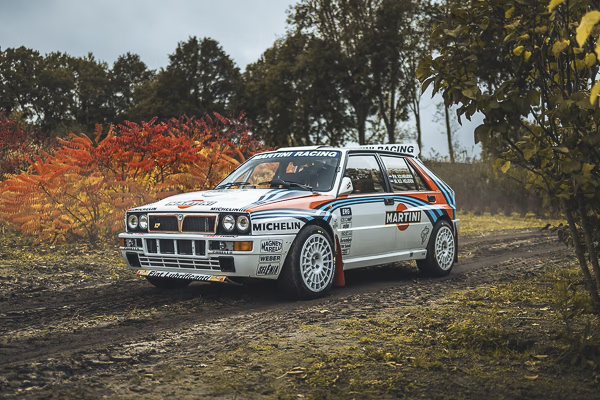
The Maturo 308 Stradale channels a half-forgotten Prancing Horse – an experiment that saw the 308 GTB competing on the special stages of Monte Carlo rather than for a parking space outside the Casino.
Beginning with an original 308 GTB donor, Maturo strips the chassis to bare metal, adds over 150 structural welds and an integrated roll cage, and reshapes the rear arches by hand in the manner of the original rally car. Despite such an overhaul, the original VIN is preserved.
.avif)
.avif)
The 2.9-litre naturally aspirated V8 is rebuilt from the ground up, gaining revised camshafts, improved airflow, modern ignition technology and a custom Capristo exhaust, with output rising to as much as 400bhp depending on specification. To cope, the five-speed gearbox receives reinforced internals and shorter ratios, with a plated limited-slip differential added to the drivetrain. The suspension has been co-developed with Tractive, a fellow Dutch specialist that counts Pagani, Dallara and RUF as clients. Tractive has developed custom electronic dampers that, according to Maturo, allow the 308 Stradale to switch between a refined grand tourer and something considerably more focused.
Don’t think the roll cage means the Stradale is uncompromising on the inside. Although only renders have been released at this point, Maturo plans to ditch the original’s fragile plastics entirely, retrimming the interior with a cocktail of carbon fibre, anodised aluminium, leather and Alcantara. The one thing Maturo has wisely chosen to retain is the open-gate gear lever. As is customary for any self-respecting restomod, the whole process can be tailored to a buyer’s imagination.
.avif)
.avif)
The car Maturo draws its inspiration from has quite the backstory. The 308 GTB Group 4 was never a full factory programme, but nor was it some privateer masquerading under the Scuderia shield. Maranello developed a prototype in-house, tested it at Fiorano with Niki Lauda at the wheel, then decided to concentrate on F1. The project was handed to Giuliano Michelotto, a three-time Le Mans class winner, long-time Ferrari collaborator, and key player in the Lancia Stratos’ rallying dominance. No wonder it came with Enzo’s blessing, with il Commendatore arranging a favourable deal with Michelin into the bargain.
Eleven cars were built, taking 30 victories across national and European championship events between 1979 and 1982, while on the world stage, Jean-Claude Andruet delivered the car’s defining result with second overall on the 1982 Tour de Corse. A Group B successor followed, but the later car was heavier and slower, constrained by homologation rules and ultimately overshadowed by the category’s collapse in 1986. But the story did not end there. The 308 programme cemented Michelotto’s role as Ferrari’s unofficial skunkworks, establishing a development thread that would run through the 308 GT/M, 288 GTO and GTO Evoluzione before culminating in the F40.
That’s quite a legacy for Maturo to live up to. Only ten 308 Stradale will be commissioned, with former WRC driver Kevin Abbring overseeing final sign-off on each car, each one built at Maturo’s facility in Uden, the Netherlands. Pricing starts from €425,000 before VAT and donor car costs.
-2.avif)
.avif)
.avif)
.avif)
.avif)



.svg)

